



Walk through any large mine site, civil project or council depot in Australia and you will spot the same structure again and again. Two shipping containers set parallel, a tensioned fabric roof arched between them, and underneath it a workshop, a parts store, a blast booth or a fleet of light vehicles out of the weather.
The container dome has quietly become one of the most common industrial structures in the country, and the reasons have less to do with the structure itself than with everything it lets a site avoid: long procurement, slab pours, and a shed that is worthless the day the project ends.
Here is how the concept works, and what to weigh up if your site is considering one.
The idea: your containers become the walls
A container dome is exactly what it sounds like. Standard 20 or 40 foot shipping containers, which many operations already own, act as the structural walls. A steel-framed fabric roof mounts to the container tops, typically fixed through the existing twistlock corner castings, and spans the gap between them.
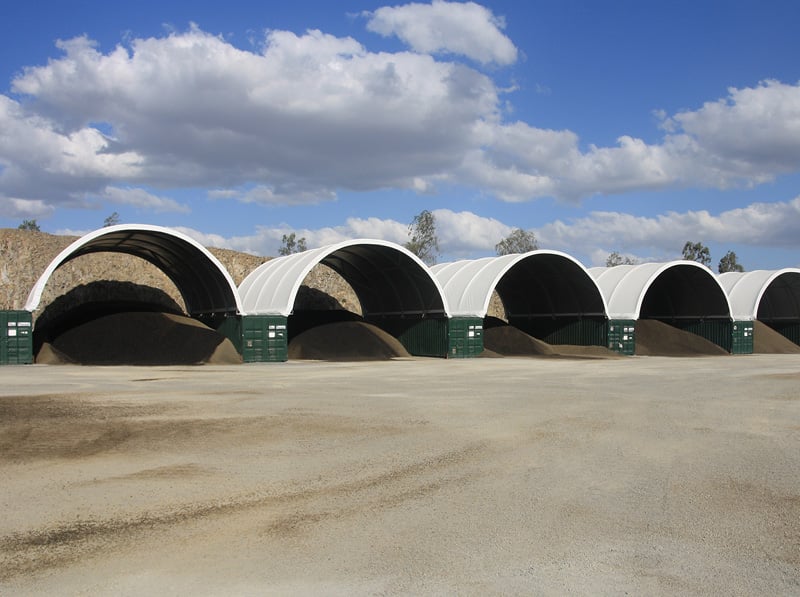
The layout does two jobs at once. The covered span between the containers becomes the working area, anywhere from around 10 metres to 16 metres or more of clear usable width depending on the model, at lengths from six metres to whatever the project needs. And the containers themselves stay fully usable as lockable storage, offices or workshops, which matters on shared sites where tools and parts walk.
Need more height? The containers can be double stacked, which pushes usable clearance past 11 metres on the larger configurations, enough for tipping trailers, excavators with raised booms, or overhead work on heavy plant.
Why the format beats a shed for temporary and semi-permanent sites
The economics come down to four things.
Speed. A fabric roof kit arrives as manageable components with instructions, and standard configurations can be dispatched fast, in some cases within 48 hours. With ballast used as the hold-down, many installations need no foundations at all, so there is no slab pour, no cure time, and no waiting on a concreting crew. A shed on the same site is a months-long procurement and construction exercise.
Relocatability. This is the one that changes the total cost calculation. When the contract ends or the pit moves, a container dome dismantles, transports and reassembles at the next site. A shed stays where you built it, and its value stays with the landlord. For contractors who move between projects, the same shelter can serve half a dozen sites over its life.
Working conditions. Fabric structures run cooler than steel sheds in summer because the membrane does not radiate heat the way steel cladding does, and the translucent fabric lets natural light through, which cuts daytime lighting costs and improves visibility for maintenance work.
Security. The mounted containers lock. On a client's site or a multi-contractor project, having your consumables, tools and spares behind container doors under the same roof as the work area is a practical advantage that open-sided structures cannot offer.
What they get used for
The versatility is broader than most first-time buyers expect. Common applications include plant and equipment maintenance for both heavy and light vehicles, spare parts and tyre storage, sandblasting and spray painting booths, boilermaker and welding workshops, refuelling and washdown stations, and covered crib or meeting areas. With endwall options, roller doors and pedestrian access doors, the structure can be closed in to suit dust-sensitive or weather-critical work.
The engineering questions that actually matter
Fabric structures are not all built to the same standard, and the differences are invisible in a photo. Before comparing prices, compare these.
Wind rating for your region. Australian sites span everything from sheltered metro yards to cyclonic coastal zones, and the shelter needs to be engineered for where it will stand, not for a brochure average. The better end of the market engineers to current Australian standards, with configurations rated for winds above 300 km/h available where required.
What the warranty covers. A warranty on the fabric alone is not a warranty on the structure. Look for coverage across all three elements: the steel framework, the fabric cover and the workmanship. Ten years across all three is the benchmark the industry leaders set, and shorter or narrower coverage should be reflected in the price.
Where it is made and who stands behind it. Locally manufactured structures mean local engineering documentation, compliance with Australian standards as designed rather than adapted, and spare panels or parts that do not cross an ocean. Certification to ISO standards is a reasonable proxy for a manufacturer whose quality systems will survive an audit, which matters if the structure is going onto a tier-one mining or construction site where compliance paperwork is scrutinised.
Fixing method. Roof kits that mount through the container's twistlock castings use the container the way it was engineered to be used. Ad hoc welded or clamped fixings are a red flag for both engineering and container integrity.
Sizing it without guessing
The trap with container domes and shelters is buying for the equipment you have rather than the clearance you need. Measure the tallest thing that will ever be inside with everything raised: tipper bodies up, booms extended, exhaust stacks included. Then add working room. Inside-mounted and outside-mounted roof configurations trade usable width against the same container pair, so the same two containers can produce quite different covered areas depending on the mount, which is worth modelling before ordering rather than after.
A supplier who asks about your site's wind region, what is going under the roof, and how long the structure will stay put is quoting a structure. One who only asks for a size is quoting a tarp.
The bottom line
For permanent head-office infrastructure, build a building. For everything else, the container dome format has earned its place on Australian sites by being fast to deploy, engineered to real standards at the reputable end of the market, and the only industrial structure that packs up and moves to the next job with you. Get the wind rating, the warranty scope and the clearances right, and it is one of the rare site purchases that still holds value five projects later.
Allshelter has been manufacturing fabric shelters in NSW since 1999 and introduced Australia's first container shelters in 2003. Engineered to Australian standards, ISO certified and backed by a 10-year warranty across frame, fabric and workmanship, their range ships Australia-wide and internationally. Explore the range or grab the full price guide at allshelter.com.au.