


The ramp is finished. The rails are level, the handrail is solid, and the participant rolled down it on the first try.
Six weeks later, you still haven't been paid.
Nothing went wrong on site. Something went wrong on paper. And on NDIS home modifications, the paper is half the job.
Quick answer: NDIS home modifications are changes to a participant's home, such as ramps, rails and bathroom works, funded from the Capital Home Modifications budget in their NDIS plan. For builders, three money rules decide when you get paid: invoice the right party for the plan type, meet all four ATO conditions before treating the job as GST-free, and claim the final payment only after completion and certification.
Minor vs Complex NDIS Home Modifications
The NDIA sorts every job into one of two groups, and the group changes almost everything after it.
|
Minor home modifications |
Complex home modifications |
|
|
Typical work |
Rails, handheld showers, lever taps, small ramps |
Structural bathrooms, permanent ramps and lifts, layout changes |
|
Cost band |
Category A under $10,000. Category B $10,000 to $20,000 |
Over $20,000, or structural at any price |
|
Structural? |
No |
Usually |
|
Quotes |
Usually not needed |
2 itemised quotes or a cost estimate |
|
Certifier |
Rarely |
Often, before the final payment |
Those bands come from the NDIS guidelines on funding home modifications. One catch: the NDIS provider guide describes minor works as generally under $25,000. So check which figure the participant's OT and planner are working to before you price anything.
So what? The category tells you whether you're quoting, who signs off, and how long you'll wait for the last dollar.
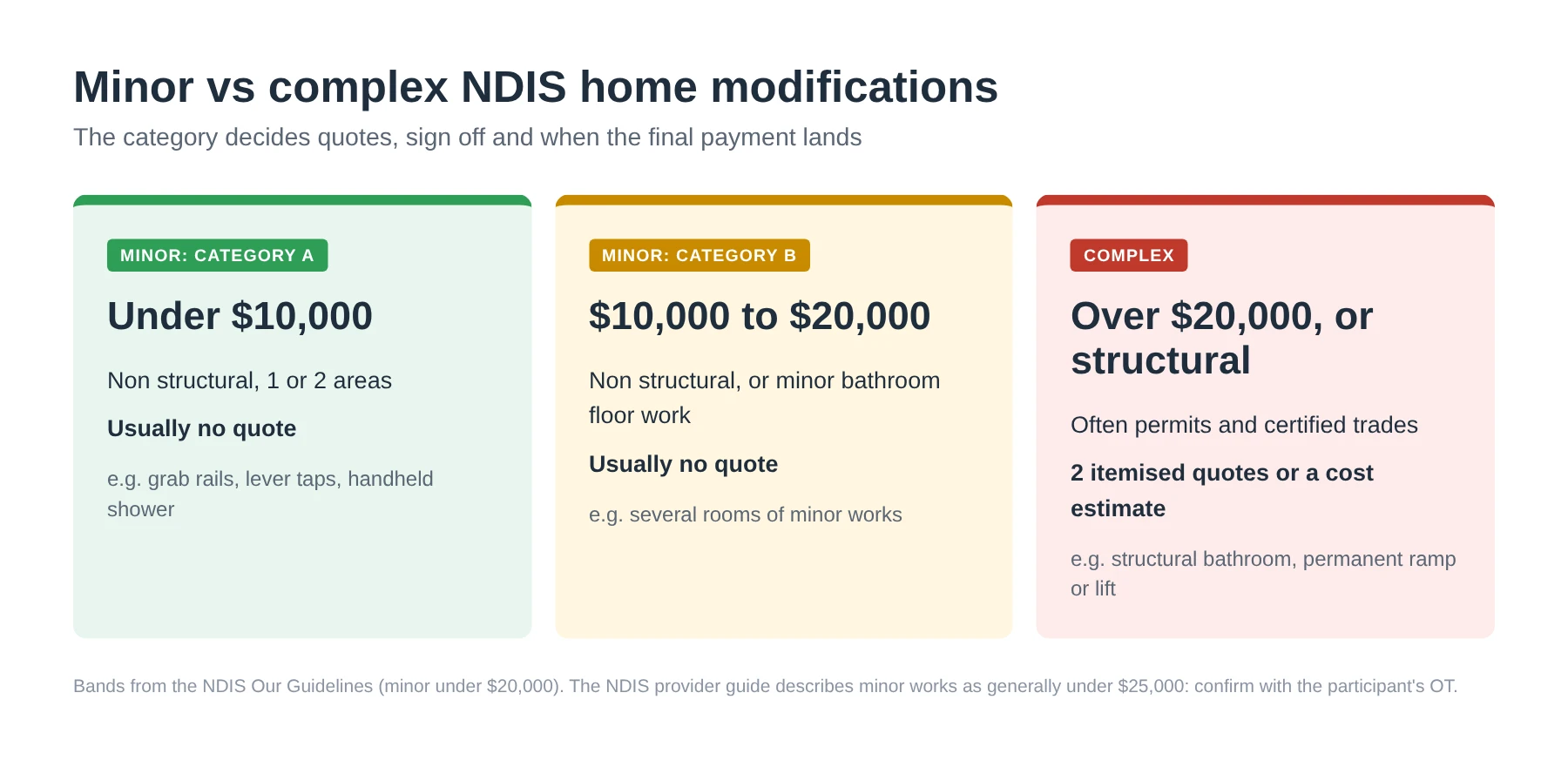
Image file: minor-vs-complex-ndis-home-modifications.png | Alt text: Minor vs complex NDIS home modifications: Category A under $10,000, Category B $10,000 to $20,000, complex over $20,000 or structural
The NDIS Home Modifications Process for Builders
Participants see the process from the funding side. You see it from the job side. Here's the version NDIS home modifications builders actually need.
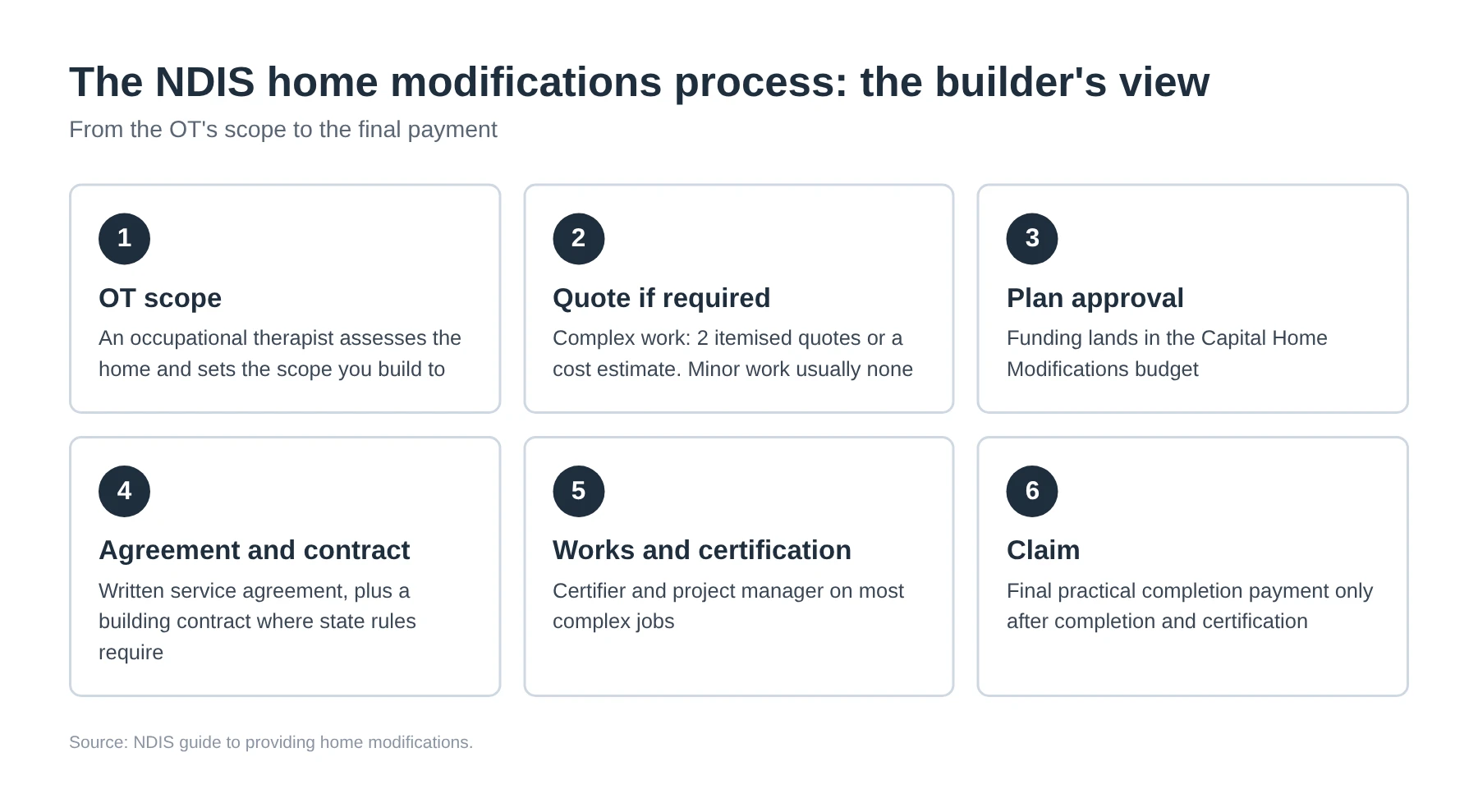
Image file: ndis-home-modifications-process-builders.png | Alt text: Six steps of the NDIS home modifications process for builders, from OT scope to final claim
1- Scope from the OT. An occupational therapist assesses the home and writes up what's needed. You build to that scope, not to a conversation on the doorstep.
2- Quote, if required. Complex work needs 2 itemised quotes or a cost estimate. Minor work usually doesn't, except in remote areas.
3- Approval in the plan. Funding lands in the participant's Capital Home Modifications budget. Work that isn't in the plan isn't covered.
4- Written agreement and contract. A service agreement with the participant, plus a building contract where your state's rules require one.
5- Works and certification. Complex jobs often involve an independent building certifier and a building works project manager.
6- Claim. Final payment comes after practical completion, including any certification.
Tip: keep the OT's scope, the agreement and the certificate in one job file. You'll need all three when the claim is questioned.
Do Builders Need NDIS Registration?
It depends on how the participant's budget is managed, which is the part most builders miss.
According to the NDIS guidelines, if the funding is Agency managed, the providers doing the home modifications need to be NDIS registered. If the budget is plan managed or self managed, registration isn't required, but you still need the right trade qualifications and licences.
So the honest answer to most NDIS home modifications registration questions is: ask the participant how their plan is managed before you accept the job.
Quoting the Job
A vague quote slows approval. The NDIS asks builders for quotes that show:
- Dimensions of the area being modified
- Separate costs for each stage of the job
- Make, model and cost of any fixtures you supply
- An overall total, inclusive of GST where applicable
Builders searching for an NDIS home modifications price guide usually end up at the NDIS Pricing Arrangements and Price Limits. Check the current year's edition before you quote, because the support items and limits are reviewed every year.
How to Invoice NDIS for Building Work
This is where the six-week wait usually starts. The right invoice to the wrong party goes nowhere.
|
How the plan is managed |
Who you bill |
What happens next |
|
NDIA managed |
No invoice. You lodge a payment request in the myplace provider portal |
Submit within 90 days of the service booking ending. You must be recorded as a "my provider" |
|
Plan managed |
The participant's plan manager |
They lodge the claim. Your ABN must be on the invoice |
|
Self managed |
The participant |
They pay you, then claim from their budget |
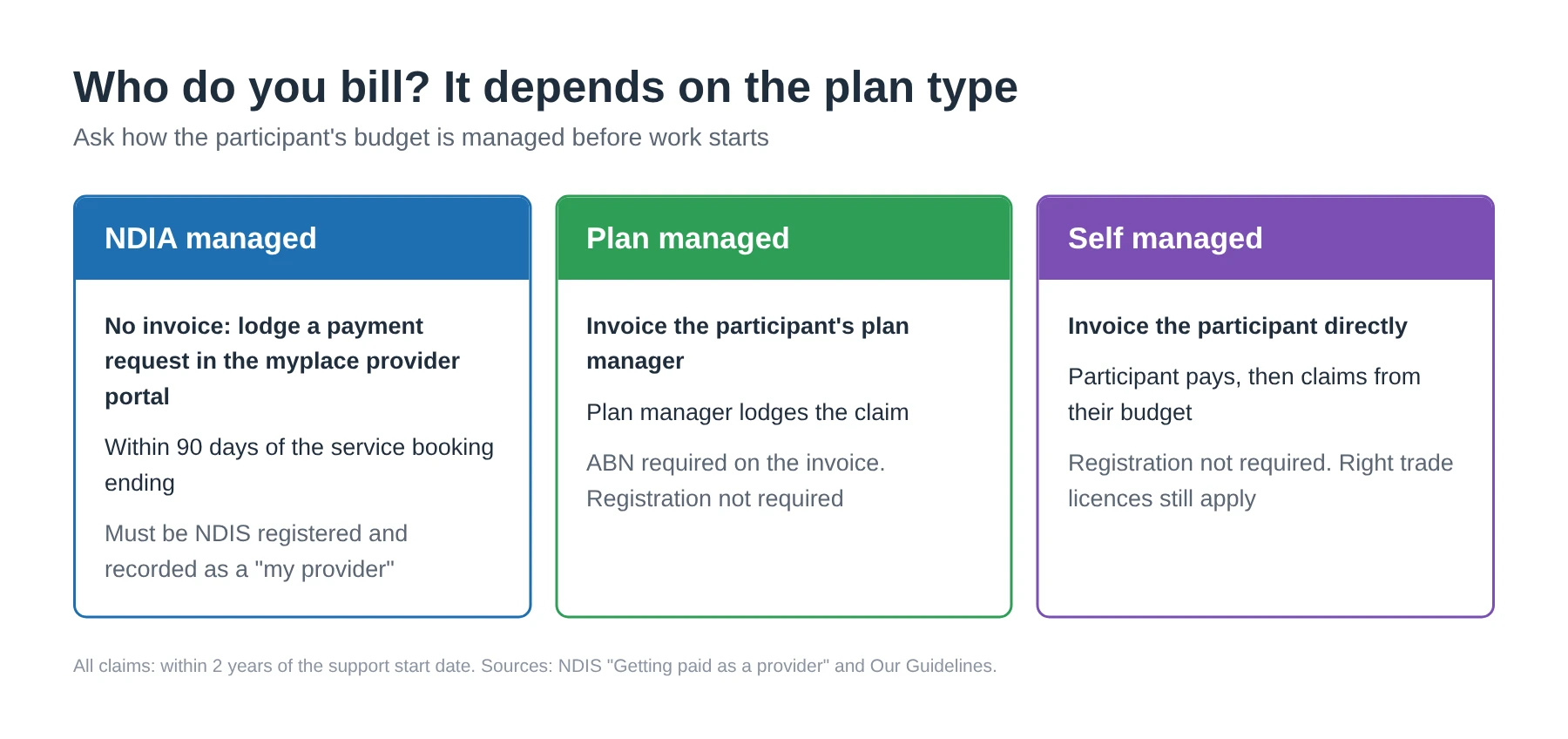
Image file: who-to-invoice-ndis-plan-type.png | Alt text: Who to bill for NDIS work by plan type: NDIA managed, plan managed and self managed
Every invoice also needs the participant's name and NDIS number, the support item, the dates of the work and your ABN. If you want a layout that already has those fields, use this NDIS invoice template and adjust it for building line items.
Two timing rules matter. The final practical completion payment can't be claimed until the work is complete, certifications included. And since 3 October 2024, the NDIA has given providers 2 years from the support start date to submit a claim.
Worked Example: A Category A Job
Ridgeline Building Co (a fictional Brisbane builder) completes a minor job for a plan-managed participant.
|
Item |
Qty |
Unit price |
Total |
|
Grab rails, supply and install |
3 |
$320 |
$960 |
|
Handheld shower and slide rail |
1 |
$540 |
$540 |
|
Modular entry ramp |
1 |
$3,900 |
$3,900 |
|
Lever taps |
2 |
$260 |
$520 |
|
Handrail to front steps |
1 |
$1,450 |
$1,450 |
|
Total |
|
|
$7,370 |
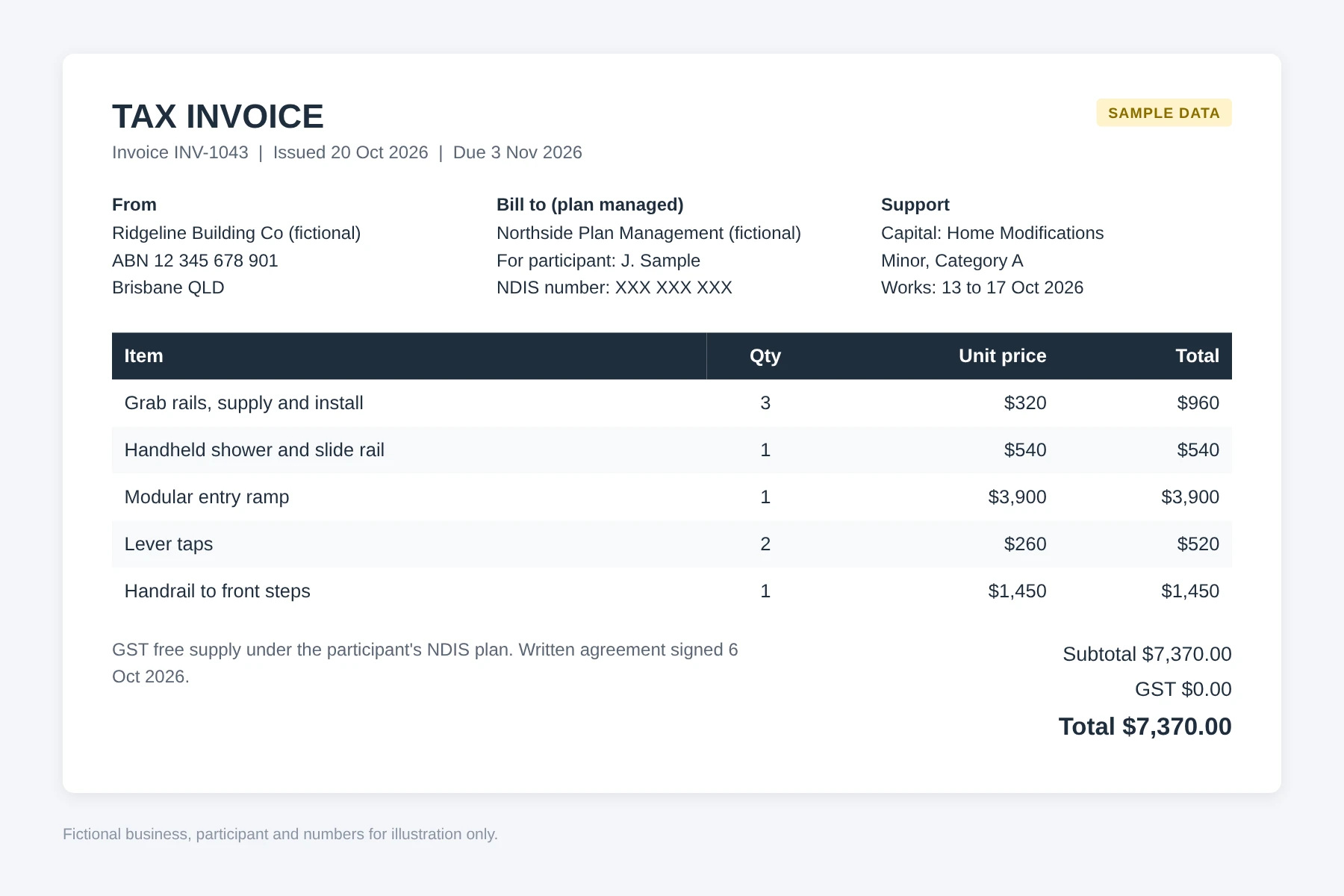
Image file: ndis-invoice-example-home-modifications.png | Alt text: Sample NDIS invoice for a Category A home modification job totalling $7,370 with GST at $0.00
At $7,370, it sits in Category A. The invoice goes to the plan manager, and GST shows as $0.00, but only because the written agreement is already in place. Which brings us to the rule that costs builders real money.
Is NDIS Work GST-Free? The 4 Conditions
Is NDIS GST free? Sometimes. The ATO's guidance on GST and the NDIS lists home modifications as a support that can be GST-free, but only when all four conditions are met:
1- A plan in effect. The participant has an approved NDIS plan.
2- Supports in the plan. The work is a reasonable and necessary support specified in that plan, and only up to the amount the plan allows.
3- A written agreement. It identifies the participant and states that the supply is a support under their plan.
4- Covered by the determination. Home modifications are listed in the current NDIS supports determination, which runs to 30 June 2027.
Now the trap. If you're subcontracted by another provider, you're supplying that provider, not the participant. The ATO's own example says supplies like that are not GST-free. Charge GST.
Worked Example: When the Paperwork Is Missing
A builder bills an $11,000 job as GST-free. There's no written agreement. If the ATO treats the job as taxable, that $11,000 is GST-inclusive, so the builder owes $1,000 in GST ($11,000 ÷ 11). It comes out of the margin, not the client's pocket.
One missing page. One thousand dollars.
Reporting NDIS Income on Your BAS
GST-free doesn't mean invisible. NDIS income still goes on your Business Activity Statement.
What is a BAS statement? It's the form you lodge with the ATO to report GST and other tax obligations, usually quarterly. If you've never seen one filled in, a worked BAS statement example shows where each figure goes.
The ATO's BAS instructions for sales are clear: G1 is total sales, including GST-free sales, and "All amounts reported at G3 should also have been reported at G1."
Worked Example: A Mixed Quarter
|
BAS label |
What goes in it |
Amount |
|
G1 Total sales |
$55,000 of standard renovations (GST included) plus $30,000 of NDIS work |
$85,000 |
|
G3 Other GST-free sales |
The NDIS work only |
$30,000 |
|
1A GST on sales |
$55,000 ÷ 11 |
$5,000 |
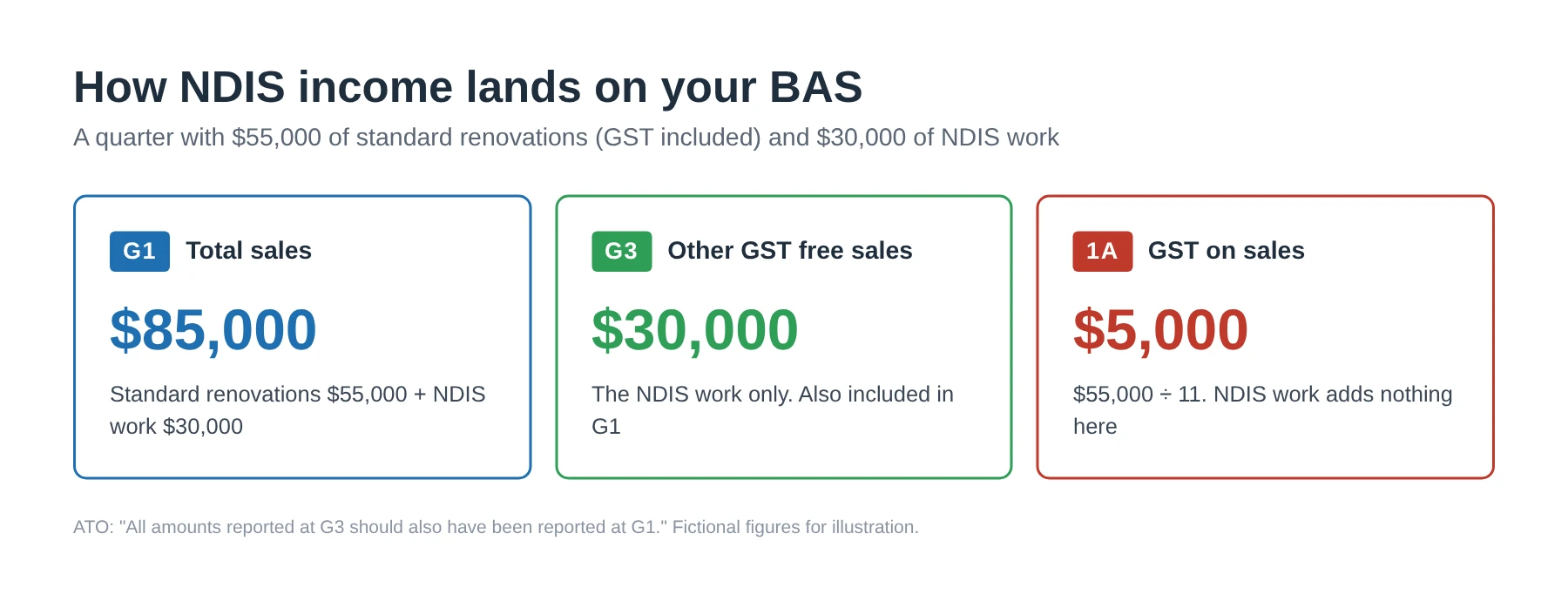
Image file: bas-mixed-quarter-g1-g3-1a.png | Alt text: BAS labels for a mixed quarter: G1 $85,000, G3 $30,000, 1A $5,000
The $30,000 sits in both G1 and G3, and adds nothing to 1A.
Common Mistakes
✗ Billing the wrong party. A plan-managed invoice sent to the participant stalls. Fix: confirm the plan type before work starts.
✗ GST-free without a written agreement. The GST becomes yours. Fix: sign the agreement before day one.
✗ Claiming the final payment early. Claims before certification get knocked back. Fix: wait for practical completion and paperwork.
✗ Leaving NDIS sales off G1. G3 alone doesn't balance. Fix: report them at both labels.
Where Software Fits
A builder running three NDIS jobs alongside standard renovations has three billing paths, two GST treatments and one BAS to reconcile.
Enerpize is a cloud-based, all-in-one ERP platform for small and medium-sized businesses, combining accounting, inventory, HR, sales, and CRM in a single system. Used by 40,000+ businesses, it lets you issue invoices, track costs per job with cost centers, and send clients a statement of what's outstanding, so the numbers your BAS needs are already in one place.
Key Takeaways
- Minor home modifications fall into Category A (under $10,000) or Category B ($10,000 to $20,000). The provider guide uses $25,000, so confirm the figure.
- Complex home modifications need 2 itemised quotes or a cost estimate.
- Agency-managed participants need registered providers. Plan-managed and self-managed participants don't.
- NDIA-managed payment requests go in within 90 days of the service booking ending, and all claims within 2 years of the support start date.
- GST-free status needs all 4 ATO conditions. Miss one on an $11,000 job and you owe $1,000.
- NDIS sales go at both G1 and G3 on your BAS.
Frequently Asked Questions
Does the NDIS cover home modifications?
Yes, when the modification is a reasonable and necessary support in the participant's plan. Funding sits in the Capital Home Modifications budget.
What is the difference between minor and complex NDIS home modifications?
Minor works are non-structural and cost under $20,000 under the NDIS guidelines. Complex works are usually structural, often need permits and certification, and need quotes.
Do I need to be NDIS registered to do home modifications?
Only for Agency-managed participants. For plan-managed and self-managed participants, you need the right qualifications, not NDIS registration.
How do NDIS providers get paid?
Through the myplace provider portal for NDIA-managed participants, through the plan manager for plan-managed participants, and directly by self-managed participants.
How long does the NDIS take to pay an invoice?
It depends on the plan manager or participant. What you control is lodging a complete claim: right party, right fields, after completion and certification.
Is NDIS home modification work GST-free?
It can be, if all four ATO conditions are met. Subcontracted work for another provider is not GST-free.
What is a BAS statement?
It's the form businesses lodge with the ATO to report GST and other tax amounts, usually every quarter.
Can I claim a deposit or progress payment on an NDIS job?
Your state's building contract rules apply to staged payments. The NDIS is clear on one point: the final practical completion payment can't be claimed until the work and any certifications are complete.
The Job Isn't Done Until It's Paid
Back to that ramp. Same rails, same handrail, same happy first roll down it.
The difference between getting paid in a week and waiting six is the paperwork you set up before the first post went in.
Build it right on paper too.
About the Author
Omar El Bahr is a Senior Digital Growth Specialist at Enerpize, where he leads SEO, content strategy, and organic growth across international markets. He is a Forbes Communications Council contributor and has written for Entrepreneur on business communication and digital strategy.
Disclaimer: This article is general information only and is not legal, tax or financial advice. NDIS rules, price limits and GST treatment change over time. Check current NDIA and ATO guidance, or speak with your accountant, before quoting or lodging.